Torsional Vibration Analysis
Standard marine TVA: mass-elastic modelling, natural frequencies, mode shapes, harmonic excitation and forced response across the operating speed range.
Torsional vibration analysis · TVA
Simulation and class-review-ready torsional vibration analysis for conventional, electric and hybrid propulsion systems.
The core question
Engines, motors, couplings, gearboxes, shafts and propellers form one torsional system with inertia, stiffness and damping. Excitation from engines, electric machines, propellers, waterjets or ice can drive it into resonance. We find out where, and what to change.
Services
You design the vessel and propulsion system. We handle the torsional dynamics — from the first mass-elastic model to the report that goes to class.
Standard marine TVA: mass-elastic modelling, natural frequencies, mode shapes, harmonic excitation and forced response across the operating speed range.
Class-review-ready TVA calculations and documentation for DNV and Lloyd's Register, including revisions in response to class comments.
Parameter sweeps and sensitivity studies to compare propulsion configurations and find the coupling, inertia or ratio that moves resonances out of the way.
Time-domain simulation of non-steady operation: start-up and shutdown, clutch engagement, generator connection, motor torque transients and fault conditions.
Simulation of propeller–ice interaction and the resulting transient shaft torque, component loads and vibratory stress for ice-going vessels.
Electric, hybrid, PTO/PTI, waterjet and unusual propulsion architectures — including highly coupled and nonlinear systems.
Vendor-independent. The analysis is not tied to any engine, gearbox, coupling or propulsion supplier.
Beyond pass / fail
Analysis is most valuable while components can still change. We evaluate coupling stiffness, inertias, shaft dimensions, gear ratio and operating speed to show which change actually fixes the problem — before hardware is ordered.
Typical finding
“A resonance occurs at 720 rpm.”
Our finding
“A resonance occurs at 720 rpm. Increasing the coupling compliance moves the corresponding natural frequency below the continuous operating range.”
Ice-going vessels
We analyse the transient loads from propeller–ice interaction with both time-domain simulation and frequency-domain methods — a particular strength for Nordic and other ice-going vessel projects.
When to call us
If any of these are on your desk, a torsional calculation is probably too.
Process
No lengthy questionnaire. Tell us about the case, we agree the scope in a short technical discussion, and you receive a clear proposal. Projects are delivered fully remotely — no vessel visit required.
A short description of the vessel, propulsion system or problem. No documents needed at this stage.
We establish what you are designing, which calculations and class rules apply, what data exist and when you need results.
Simulation scope, applicable rules, required input data, deliverables, design alternatives, included revisions, schedule and price.
Mass-elastic representation of the full drivetrain: engine, crankshaft, flywheel, coupling, gearbox, shafts, motors, generators, PTO/PTI, propeller or waterjet.
Natural frequencies, mode shapes, Campbell diagrams, vibratory torque, torsional stress, critical speeds, barred speed ranges, time histories and sensitivity results.
Not just graphs. Which mode is responsible, what excitation drives it, whether limits are exceeded — and what changes improve the design.
Professional PDF documenting requirements, methodology, assumptions, component data, results, limits, barred speed assessment and conclusions.
Standard TVA
Quoted per project
Scope sets the price, and a simple project stays simple to buy. A standard analysis includes:
Priced separately when needed
Framework agreements available for recurring work — shipyards, integrators, engineering offices and component manufacturers.
Open source
Our team develops OpenTorsion, the open-source Python library for torsional vibration modelling and analysis. It's publicly inspectable proof of how we model drivetrains — finite element shaftline models, natural frequencies, eigenmodes, forced response and time-stepping simulation.
OpenTorsion is the technical foundation. Next comes a professional torsional vibration analysis tool built on the same experience: graphical shaftline modelling, component libraries, class-rule checks and automated reporting.
import opentorsion as ot

# Engine, coupling hub and propeller as lumped inertias
disks = [
    ot.Disk(0, I=1.2e3),
    ot.Disk(1, I=85.0),
    ot.Disk(2, I=2.4e3),
]
shafts = [
    ot.Shaft(0, 1, None, None, k=4.1e6, I=0),
    ot.Shaft(1, 2, None, None, k=9.8e6, I=0),
]

assembly = ot.Assembly(shaft_elements=shafts, disk_elements=disks)
lam, modes = assembly.undamped_modal_analysis()

ot.Plots(assembly).plot_eigenmodes(modes=2)
Who we work with
For teams that need torsional vibration calculations regularly — but not often enough to justify a dedicated internal specialist.
You design the vessel and shaftline. We perform the TVA and prepare the class calculation.
Newbuild and retrofit yards needing class TVA once engine, gearbox, coupling, shaftline and propeller are selected.
You deliver the propulsion package; we are the torsional specialist on every project.
Application engineering, unusual installations, hybrid and electric arrangements, independent analysis.
Coupling selection, stiffness optimisation, gearbox integration and component load calculation.
Complete engine–gearbox–shaft–waterjet drivetrain dynamics, including transients.
We act as the specialist subcontractor for the torsional part of your design project.
Repowering, retrofits, drivetrain failures, operating restrictions and independent assessments.
We do
Model and simulate the drivetrain.
Where measurement data already exist, we can use them as input or for comparison against simulation.
We don't
Perform mechanical or measurement work onboard.
No shaft installation, alignment or vibration measurements, condition monitoring, balancing, repair, commissioning or inspection.
The engineers
Marine Engineering Dynamics is run by its two founders. The engineer who scopes your case is the engineer who builds the model and signs the report. There is no handover to a junior team.
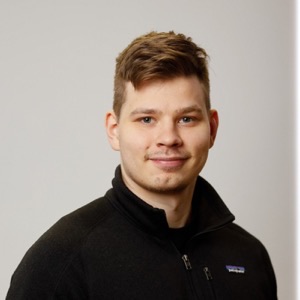
Co-founder · D.Sc. (Tech.), rotordynamics
Doctorate in rotordynamics, lateral and torsional, covering bearing, support and foundation modelling and fluid–rotor interaction. Lead contributor to OpenTorsion, the open-source torsional finite element library from Aalto University's Arotor group. Writes much of our simulation code: finite element models, spectral methods in Python, and simulation of electric drives and power electronics.
LinkedIn
Co-founder · D.Sc. (Tech.), mechanical engineering
Mechanical engineer with a strong background in software engineering, and a contributor to OpenTorsion. Builds the tooling that turns repeated calculation work into reviewable analysis: model assembly, parameter sweeps and report generation. Also works on drivetrain modelling for conventional, electric and hybrid propulsion.
LinkedInContact
Send us a short description of the propulsion system or calculation you need. We will review the case and get back to you to arrange a technical discussion.